Tags
Copper, Copper Pen, EDC, EDC Fountain Pen, pocket pen, pocket pens, Ruth Bolton, Shibui North, Shibui North Pocket Pen
It has now been just over two years since I first reviewed a pen from Shibui North and since then Ruth Bolton’s range has changed and expanded. Come late 2022 I reviewed the first of her pocket pens, the Kitsune (in Japanese folklore a manipulative, magic possessing, shape shifting, multi-tailed fox). Come her first pen show appearance, October in London, an expanded range of PVD and Cerakote coated pens were on display. None quite appealed to me, however come the Spring 2023 show one did, a copper pocket pen.
There is something appealing about copper. Some will say it is the anti-arthritic properties (scientifically proven to be an old wives tale), some will say it is the memory of copper cooking pots (even to this day the best material for heat control), however for me it is the warmth of the colour. Between Bronze, Brass and Copper, the latter has always been my preferred choice.


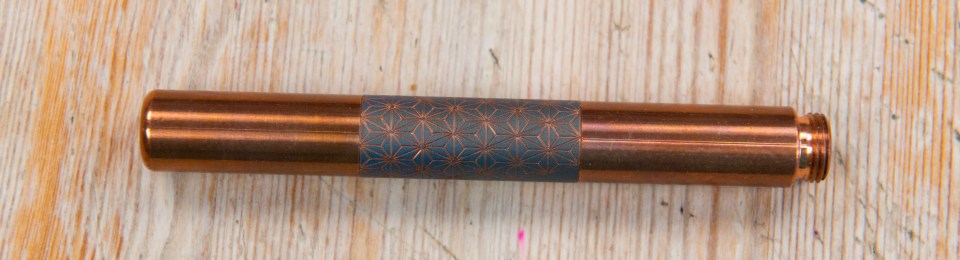
One of the things I like about Ruth’s present range of pocket pens is the way she applies the patterning through the Cerakote. Unlike some of her other pens, it is cleanly done with a single diagonal band. While it may be my personal preference, I find some of her other pen decorations to be overly fussy and a little hard on the eye. With this pen, what stood out, was that the cap and barrel were left untouched, leaving the beauty of the copper there to see, while the base material also shone through the patterning in the grey coating on the section. What I was not so keen on was the Cerakoting of the nib, the pattern does continue on through that and does almost line up, which I do consider a nice touch.

For me I find PVD and Cerakote coated nibs look ‘dirty’. I have rarely seen it done neatly, not even by the nib makers. Additionally over time the coating can and will peal, at which point they look tatty. There is one other issue for me as well. Inevitably the tipping also gets coated. Now with the latter it will wear off, fortunately, but this affects the initial writing experience adding an unpleasant scratchy feel.


Here the three pieces of the cap, section, and barrel (with the exception of the threads at the back) line up neatly with the only slight difference in width being due to the Cerakote layer on the grip. The coating is neatly done and the patterning is smoothly cut in to it as well as the underlying copper. It is also relatively subtle and while I would have preferred the patterning to be in the top of the pen when writing, it does almost line up with the patterning on the nib, which will have been by design. I say almost because quite possibly it originally did, but with unscrewing and replacing the nib unit for cleaning may have adjusted the alignment.


The cap removes in four turns. For some this will be far too many, however it does offer the advantage that I have suffered little ink evaporation with this pen, normally something of a side effect to metal threads. One thing though, if you hold the barrel rather than the section when going to remove the cap, it is the barrel that unscrews. Virtually every time. Unless regularly used it is easy to forget to hold the section, after all muscle memory works on the cap, the part you want to take off. Still if you remember then the cap comes off with little resistance and normally goes back on smoothly.


The cap posts, screwing on to the back of the barrel to produce a reasonable length pen. Without doing so the pen is too short for anything more than quick notes, but then this is a pocket pen and it is by design. There is one thing I am not a fan of though, the threads at the back of the barrel are sharp and it is noticeable. I kept the pen in a loop attached to my pocket journal, however if you were to put this pen in your pocket I would suggest there would be a risk of catching and laddering or ripping the lining. Looking through a loupe, the sector which is the issue is not where the threads start, this is fine, but rather on the other side. I’m not sure whether the threads could be manually smoothed or if they just need to be a bit wider, I suspect the former.

In the hand, with the cap posted, this is a comfortable pen to hold. While there is no indentation or shaping for a traditional section, the width of the pen is just at the right level to allow for a comfortable grip. Also the Cerakote coating adds a slight bit of needed friction. For those who like to hold their pens right by the nib I would suggest trying a more ‘normal’ position, as you will be touching the threads and as with the ones at the back of the barrel, they are sharp. With a more traditional hold this is not an issue.

Unsurprisingly this is a heavy pen for its size, coming in at roughly 62g, with the cap weighing 14.3g and the section/body at 47.5g. It is the penalty you pay for this material. It does mean the balance is slightly further back than on many other pens, but I do not see this being an issue as it is still forwards of the centre.

The nib is the standard unbranded medium Bock #6. On the plus side this has allowed Ruth to Cerakote it and add the same patterning from the barrel, with the two sets almost lining up. Down side for me is the new unbranded Bock nibs are over stiff for my personal preference and lack character. Ink flow is decent and the coating on the tipping wore off quickly, saving me having to use some micro-mesh. Having said that the nib writes like a fine. As others are reporting the new Bock nibs are producing lines thinner than you would expect, I think this is nib related not due to the Cerakote.

The pen is filled through a short international cartridge, however a Kaweco small piston converter will almost fit. It is about 3 mm too long, so I would suggest, if using one as I am, filling then expelling a little ink before putting the barrel back on.


The packaging is interesting, minimalist and slightly different. The pen comes in a velvet sleeve, which itself is in a cork lined (on the outside) cardboard sleeve. On the front is stamped branding for Shibui North.


So my thoughts. Well this pen cost me £100 at the show, a reasonably price for a metal pocket pen, and interestingly the same price as Ruth’s other stock. I do not know if this was by accident or if she just has set prices for types and slight increases for additional work and decoration. I would have expected copper to be more. Over all it is a good looking pen, and through a little abuse on my side, is starting to gain minor dings and scratches, all part of the patina that you are always going to get with a bronze pen unless you treat it with kids gloves. I used my as the pen attached to my Midori Traveller Passport journal, while tight it fitted in the pen loop and slid in an out with a nice level of assurance it would not fall out. Having said that the four turns to remove the cap made it a little impractical for this use. It was only removed to test the Ion Infinity 2, though I was already thinking of trying the more practical Sailor Pocket Pen or bringing back my Pilot Elite, which indeed I did.

So what do I not like. Not much really. The threads on the section and barrel for attaching the cap are sharp. Oddly the ones on the section to mount the barrel are not. I personally think they need going over with some form of buffing or sanding material by who ever is machining the components. I know at First Ruth was doing this but I think she may now outsource (as many one man/small pen making companies do). The only other thing is the fact that hold the cap and barrel, unscrew, and it is the latter that comes off the section virtually every time. I have seen various attempts to get round this by other makers, normally based on different threads, but the most effective way seems to be a small rubber o-ring. You can see from the pictures that on every thread there is a sizeable gap on the inside, perhaps this could be used for that purpose. Finally, on occasion I find resistance mid way through replacing the barrel. I can not see detritus in the threads, but it could be. Note when this happens the barrel does not unscrew instead of the cap.
Would I recommend this pen to others? If you can get to a pen show Ruth is attending (London ones, not sure about the others though I suspect the Northern ones as well) then it could well be worth your time hunting down the Shibui North table. Ruth does some very nice work and in the last two years her product has improved in leaps and bounds, however you may want to look at and try the pens yourself first. I might be nit picking a little here, but it’s the little finishing touches she needs to get on top of, and I am certain she will.

Pros:
- Nice size.
- Nice balance.
- Very good price for a copper pen.
- Nice design.
- Surprisingly low level of ink evaporation for a metal pen (see neutral on cap turns).
Neutral:
- Decent price for a small maker metal pocket pen.
- Pattern on the nib almost lines up with the barrel.
- Four turns to remove the cap (see pro on lack of ink evaporation).
Cons:
- Cerakoted nib (for me).
- Tipping was covered with Cerakote.
- Sharp threads.
- Barrel normally unscrews rather than the cap.
Writing Sample:

Comparison Photos:
First with the ubiquitous Lamy Al-Star/Safari.


Next with three other pocket pens. From left to right, Modern Pilot Elite (E95S in the USA), Gravitas Pocket Pen, this pen, Kaweco Bronze Sport.


 dapprman
I agree with you about the material of the pen. I like the copper, I like the ability to post the cap by screwing it onto the barrel. That is an upchjarge option – correct? But I hate that nib. I usually buy vintage and nibs which resemble that one are usually headed to the garbage. I won’t even consider new pens with the black nibs. Just a personal bias.
No the screw threads on the back of the barrel are standard. You might be confusing the up-charge option with the ION Infinity II I reviewed a week or two back where you choose your barrel and cap finials but can buy extra.
Exactly
Pingback: Sunday Reading for August 13, 2023 (DC Recaps Edition) - Madcity Supplies
Winning the Shibui North copper pocket pen has been an absolute delight. The intricate patterns created through Cerakote coatings make it a true work of art, and the warmth of the copper adds a unique touch. Despite some minor reservations about sharp threads and nib coatings, the pen’s balance and size provide a comfortable writing experience. It’s remarkable how such a beautifully designed pen can enhance my writing journey, making every stroke a pleasure. This pen has truly become a prized possession that I can’t help but admire and enjoy every time I put pen to paper.
Pingback: Pens in Daily Use August 2023 | dapprman
This looks like a nice enough pen, but there’s just something off about Shibui. The current models look like they were heavily inspired by Gravitas and the early “Japanese” ones came around when Urushi and everything Japanese was very much en vogue in the fountain pen community (btw. the Shibui website currently only says that Ruth spend 10 years in Japan and there is “a lot of Japanese aesthetics” in her work. Fair enough, but quite a difference from being ” a westerner that has spent 20 years in Japan studying and working with this lacquer (Urushi)” as you mentioned in your review of the Kibo Urushi pen).
I’m sure Ruth is a very nice person and this sounds a lot harsher than I intend it to be, but I think she definitely still needs to find a unique and consistent underlying aesthetic/artistic philosophy and approach to her work. There is some talent there and almost always also some good ideas, but there’s also a lack of artistic consistency.
Rather than aping what’s currently en vogue and doing takes on what’s already out there she should just try to do something that is uniquely hers and I don’t think the current models are there yet.
Pingback: Personal Fountain Pen Round Up for 2023 | dapprman
Pingback: Gravitas Skittle Dinkey | dapprman