Tags
Aurora is one of the oldest surviving pen makers in Italy. Founded in Turin in 1889 as an importer of Remington typewriters, come 1919 they started to make fountain pens (history taken from the Aurora website). These days they are probably best known for two related models, the cigar shaped 88 and the flat topped Optima. Many, like this pen, are made using Auroloide, a form of celluloid, which over time has been reformulated to be more stable.
Considering my liking of Italian fountain pens, it may come as some surprise that this is my first Aurora. The reason has always been one of personal preference. Not in looks, as I have felt many of their pens to be stunning, and in the hand comfortable, but their nibs. I like soft and bouncy ones, such as are found on OMAS and ScriBo, where as Aurora nibs are traditionally stiff and pencil like with a little feedback. Much like those made by Sailor.

While not the only pens made with this material, Aurora have a range of optimas under the Auroloide branding. A number of attractive cracked ice models in different colours and trim finishes. I think the most common one I have seen is the blue model, however in the flesh this green pen jumped out at me.

I had not intended to buy an Aurora at the Spring London Pen Show, after all I have tried multiple models and the nibs are just not to my taste. Problem is I have always taken an interest in the Aurora UK table and the eye candy there. This green optima really caught my eye and so smugly I asked if I could give it a try, safe in the knowledge I would not enjoy the experience and so return the pen to it’s box. Problem with being smug is that’s the point when plans fail and instead of disliking the experience I found a smooth nib and a pleasurable experience. A purchase was made.

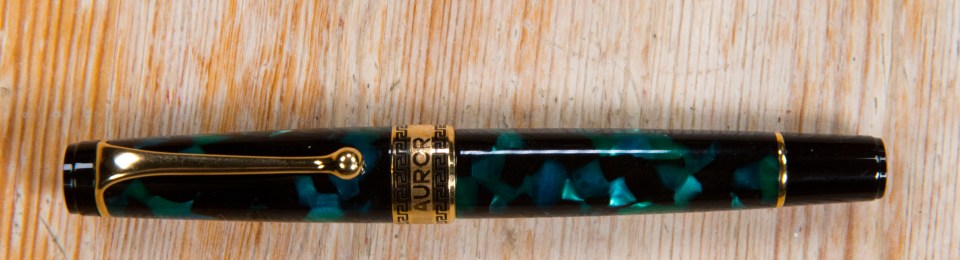
While the section and finials may be black, meaning the green Aurorloide only being used for the main stretches of the cap and barrel, the combination works well and the gold metal work helps frame the celluloid. There is a depth to the chatoyance, with variation in tones depending on the angle of reflection. Some of the green parts are so deep that with the light behind the pen you can see the nib and the piston rod. There is almost a raden like pearlescence to the lighter parts. At first glance this is an attractive pen, take a closer look and this material really does stand out when compared to many of the other cracked ice finishes in the market.

Now I must admit I do not know what many of the early Aurora pens looked like, but there is something rather classical in the looks and size of the Optima model. In some respects it is the detailing. Nothing jumps out but there are a number of subtle touches that aid the total effect.


The cap is typically Italian with a wide band at the opening, patterned with two lines of Greek Keys. Between these you have the text AURORA below the clip and ITALY on the opposite side. The band the letters sit on is matt in nature due to being stamped or moulded, I have checked under a loupe and the back ground is not laser engraved. The clip band is comparatively subtle and the same width as the one at near the end of the barrel. There is a subtle step at the end of the finial, almost as if originally a band or cap was placed over it. This works nicely and helps add to that classical feel. The top of the finial curves up slightly in a very subtle dome. One thing I did notice is the cap and clip bands are slightly raised compared to the material, again a subtle and well done hint to past designs.

The cap removes in just one and a third turns, which will please many, and can be comfortably and securely posted. While this does affect the balance, it is not by as much as I would expect as the barrel sits quite deeply within the cap. Also despite being quick to remove, the cap does a remarkable job of sealing the nib and I have experienced very little, if any, ink evaporation.


The clip is one piece of sprung metal curved round with a ball at the end. It works well at holding the pen in place, however I did find the ball did not like going over fatter seams without a little pressure. I would be intrigued to see how the clip is made as looking at the underside I am left with the impression that the edges have been rolled inwards. Also on the inside you can make out the word METAL has been stamped.


The section has a very traditional look, what I would describe as being chess piece like. There is a gradual taper down from the capping threads till just before the end where it expands out to form a substantial thumb rest. No risk of accidental inky fingers here. The threads are fine and subtle, barely noticeable when you first pick up the pen and so soon forgotten. The ink window is clear and works very well. There is a step up to the barrel and this is the one slight weak point of the design as you can feel a slight edge despite the angle of the metalwork. It is not that bad and even if you hold the pen quite far back, it does not dig in. The band is almost certainly there to protect the barrel material from damage when closing the cap. Interestingly is it flush with the barrel, the only piece of metal work that is not raised compared to the Auroloide. The barrel gently angles in towards the end where there is a band before the piston knob. As with the cap finial, this ends in a small step.

There is branding stamped on one side of the barrel, two lines around and Aurora badge, Fabrica Italiana Di Penne A Serbatoio. I do not feel this has been that well done. There is a slight inconsistency in the depth of the letters, making it hard to read unless the lighting is just right, plus it does not line up neatly with the nib.


The nib is Aurora’s own in-house 14k gold piece, mounted on an ebonite feed and held in a screw-in unit. The latter helps make cleaning this pen some what easier. The patterning on the nib is quite traditional though missing the size. This is actually impressed on the feed towards the front. For me that is a M for medium.

The writing experience is very much paper dependant, but not in a bad way. The nib works very well and has a decent level if ink flow. On the more glossy types of paper there is the buttery experience I much prefer while on the less treated paper the writing experience is more pencil like. Additionally there is a slight squeak to the nib. This will be down to this particular nib and I have no problems with it, though it does show the advantage of being able to test a pen before buying.

The filling system is a piston mechanism with a slight twist. Winding in and out the piston is an easy experience and I got a decent fill first time round. One thing to be aware of though, and this affects cleaning, is the piston rod is hollow and so acts as a reserve ink store. It does mean that when the pen looks near empty you do have a safety margin. The downside is this can make cleaning the pen a little harder, though remove the nib section and you can use a syringe to inject water at the opening to the rod.


The pen comes in a comparatively large box, though seemingly the standard one for most Aurora pens. It feels as if it is made from cardboard and hinges open with a hidden magnetic clasp. Inside the velvet line tray hides all the paper work and there is a metal plaque detailing the nib material. A nice touch, but at the same time it is a shame is does not give the size.

So what do I think. Well this could have been an expensive mistake, not because of the cost of the pen, but because I now know there are some Aurora pens I like using and that means more available to me. Almost certainly any will be pen show purchases as there are some good deals to be found at those and the Aurora UK table does seem to be cheaper than anywhere else in Europe. I do love the material of this pen. At first I thought the black section may detract, but that was only for a short while. There is something very typically Italian about this pen, an understated elegance.
Cost wise, you must remember the market segment Aurora sit in, alongside the likes of Pelikan, Montblanc, ScriBo, Visconti, etc., etc. On the Aurora website this pen goes for €660. Iguana Sell presently have the range reduced from £570/580 (€664/675)to £480/495 (€560/755), and I think this pen was going for just £435 at the pen show where I bought it (I did say there were some good deals to be had).
One thing I have not mentioned is reliability. Italian pen makers do not have the best of reputations for build quality. These days not all are bad and in fact some are very good, however looking through forums and talking to people I know who own their pens, it appears Aurora make some of the best made and most reliable fountain pens out there, if not the best. We are talking rivalling Sailor but with decent piston fillers. Sure there is the occasional blip, these are hand made pens after all, and I do know one person who had an absolute mare with his, but that appears to be rare.

So could I recommend this pen to others. Cost always comes in to it, as does personal preferences on pen size and nib feel. This is not a cheap pen, however if it is within your budget and you like the look of it (or another of the Auroloide range in a different colour) then I do suggest trying one, if possible, with the view to buying. It will not suit everyone but if it does then this could be a keeper.
Pros:
- Beautiful material.
- Elegant design.
- Nicely balanced.
- Posting the cap does increase the length but does not affect the balance point much.
- Very effective ink window.
- Nib unit can be unscrewed to help with cleaning.
Neutral:
- Nib may be too stiff and pencil like for some.
Cons:
- Step up at the back of the barrel can feel hard/sharp if touched in the wrong plane.
- Stamping on the barrel is inconsistent.
Writing Sample:

Comparison Photos:
First with a number of rivals and a couple of modern pens based on classical designs. From left to right, Stipula Etruria Faceted, Montblanc 146, this pen, Lamy 2000, Onoto Magna Classic.


And now with the ubiquitous Lamy Al-Star/Safari.


 dapprman
A lovely pen. There is beauty in some of the simplicity (the cap clip) and I appreciate how the barrel steps down to the section allowing the cap to perfectly align with the barrel.
I have this exact pen and it has been bullet proof for the 10 or so years I have had it. A classic.
A lovely pen and a worthy addition to your flock. I have the red version. Worth mentioning that Aurora offer lots of nib options including obliques in fine, medium and broad. The Aurora 88 and the Talentum are also very enjoyable if you are venturing down this rabbit hole and all use the same screw in nib units.
Thank you for this detailed review of a most attractive pen. I already have the Orange Black, Purple and Blue versions, all of which feature regularly in my pen rotations. The Orange has a generous medium nib which I find less satisfying than the fine nib I have on the Purple (but then I am a great fan of Sailor or Platinum pens). The star of my Aurora collection, however, is the soft fine nib on the Blue version: this produces extraordinarily subtle lines and is a wonderful writing instrument.
I am now considering whether to add the Green to my collection, once I have enough money in the ‘pen reserve’… Your thorough and thoughtful review has been really useful in convincing me that I should make that decision soon!
Pingback: Personal Fountain Pen Round Up for 2023 | dapprman
Pingback: Daily Carry – May 2024 Edition | dapprman