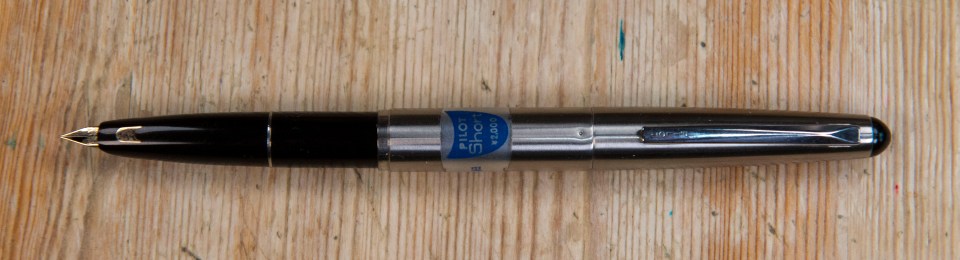
So there I am last March at the Spring 2024 London Pen Show with a table and no intention to buy more pens. A wander around to say hi to friends resulted in me chatting with the people at Vitstyle on of all things places to go for dim sum we both knew in Hong Kong when I realised the pen I was fiddling with I rather liked.


At first this just looked like a short version of the sort of pocket pens found in Japan in the 1960s and 70s, but this Pilot pen has a trick. The section is telescopic, sliding out of the barrel. Net result is quite a clever design providing a full sized pen. Dating from either 1967 or 1968 (I think the only way of telling is by disassembling), from a blog post by Chris Raper it appears Pilot only made this style for three years before just sticking with the more traditional model we are used to. Mine is marked on the barrel with ID19, not matching any of his but that could be a batch ID. I have looked else where and can find next to nothing more (aside from some dead sites). As this was ¥2000, ¥500 more than the Sailor Slim Mini Pocket Pen from the same time, I suspect this design was possibly too expensive to be competitive.

Visually the pen is very much of its time. Steel (or maybe ‘white metal’ or aluminium) and black plastic in a rocket type shape. A time of looking to the future. Sitting next to the more ‘normal’ pocket pens from Pilot, Platinum and Sailor it actually looks slightly dated even then, but that also meant it stood out (hence me picking it up and fiddling with it).

The uncapping process is a core part of the fun of this pen. There is an inner clutch so when you go to pull the cap off it extends the section, terminating in a satisfying pop. Putting the cap back on and you need to remember to push far enough to get a click. Of note I found this pen does seal really well and despite limited usage in just under a year there was still ink in the converter.


While designed for posting, this pen is long enough that you do not need to unless you have large hands. It is actually as long as a Pilot Custom 823 from where the nib meets the section to the end of the barrel. Post adds a couple more centimetres. Being such a light pen the balance is towards the front even when posted.


The clip is quite stiff and needs prizing gently outwards to fit over a pocket seam but it does keep the pen nicely in place. Still this sort of pen is more designed to be kept loose in a pocket or bag. I would not try to force this over too deep a seam or edge though as it looks like the clip is just stamped and folded ‘white’ metal held in place in the cap by bent prongs. The latter could break.

When looking at the finials head on you can see a breather hole at the end of the barrel. This almost certainly is there to allow the telescoping mechanism to work, though on testing I could not feel any air coming through it.


The nib is 14k gold with this particular pen sporting a fine, which being Japanese means extra-fine when compared to a European nib from the likes of Bock and JoWo. Being small and with such narrow tipping there is next to no flex (though you can safely force a little line variation) and the writing experience is rather pencil like. For a Japanese fine nib it is surprisingly wet for its size.

The filling system is Pilot proprietary cartridge and converters. Yes it will fit the latter and Vitstyle provided me with a Con-40 with the pen. While this works and is slightly more reliable than other Pilot converters I am not a fan as it is very hard to fully fill one of these unless you use a syringe.


In the hand, for me personally the Pilot Short is a little too narrow. Great for quick notes, but not so for serious pieces of writing. Still that’s really much of the point of this pen. Something small and light weight that can be pulled out of a pocket or bag for making some notes. The section is long, giving many options on where to hold this pen, however I find I tend to rest my first and fore fingers plus thumb on the forward clutch ring, the one that helps extend the pen when you remove the cap. I stop noticing after a while but at first, each time, there is a slight discomfort.

I might start using this pen with my Midori Traveller Passport Journal, and see how that goes, but to me this is more a curiosity and fun pen for the collection rather than one to seriously consider using despite it being on my table as part of the ‘daily use’ collection.

While at first it might seem odd to recommend, or not, a pen that has not been made for close to 60 years as these do come up at pen shows and on auction sites I feel I can give my opinion. If you are a collector who is not bothered about using the pen then this is an interesting and unusual addition. However, if you are a user and like the look/sound of this pen then I suggest checking who will be at the pen shows you can attend to see if they have one they are bringing with them. Having said that the width is comparable to other pocket pens from the past, though it is narrower than a modern Pilot E95S/Elite.
Pros:
- Unusual pen.
- Full length when extended.
- Does not need posting (except for people with large hands).
- Takes modern Pilot cartridges and converters.
Neutral:
- On the narrow side.
Cons:
- Upper clutch ring is where many of us will hold the pen.
Writing Sample:

Comparison Pictures:
Here with (L-R) Gravitas Quark, Gravitas Dinkey, Sailor Pocket Mini, this pen, Pilot Elite (modern), Kaweco Sport, Pelikan M200.


 dapprman
The telescopic section is most intriguing. Given time, I would assume the section would take the brunt of the telescopic function. If you make this the companion to the Midori Traveller we shall see.
Pingback: Sunday Reading for February 16, 2025 – Madcity Supplies
Pingback: Pens in Daily Use May 2025 | dapprman