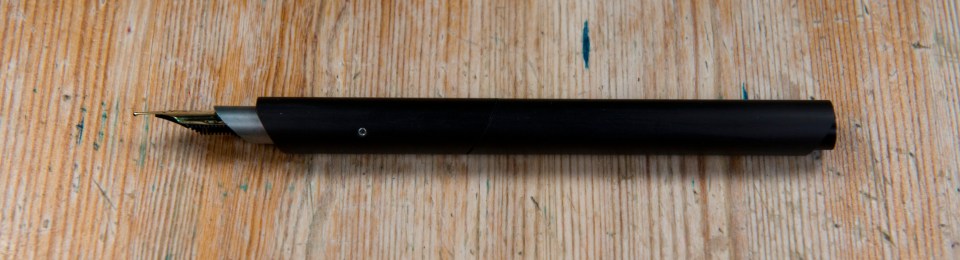
Right from the start Venvstas have taken a different view with the design direction of their pens, some times a little controversial as architectural and design directions have been taken rather than looking at usability. Over time the company has learnt and a few years back they launched the second generation of their piston filler pen. Here I get the chance to test it.
First off disclaimer time. I was leant this pen by Filippo Carmignani Tirelli, the surviving founder (once restarted in Parma) and owner of Venvstas. It will be returned back shortly after this review has been completed.

I am not sure where to start with Venvstas pens, so please check the end of this article for a histrory1, which includes a little speculation. This company has colour and I would actually consider the present Venvstas to be either version 2.0 or 3.0. Certainly in the past, before the move from Paris to Parma there was a spin off with a new Kickstarter project The Edge under the U75 brand (and shortly after the Kickstarter Venvstas account being deleted). I detailed my experiences with The Edge five years back.

There are a number of original design philosophies that have been carried on through all the Venvstas range. Central to this is a tubular shape with the pen being made from carbon fibre with stainless steel brackets and components to keep everything together. To quote the website:
Underlined by sophisticated aesthetics coupled with innovative construction methods, these are the only writing instruments in the world which features a fully linear carbon fiber body, one of the strongest, yet lightest, material on earth. To be processed, carbon fiber requires a mixture of technology, experience and skilled work that only our Italian artisans could have.
Each pen comes from a 17cm element sawed with a diamond blade from a meter long tube.
It is then sawed again to create the individual components that must be labelled to match together smoothly when assembled.
Many more passages are needed before the carbon body elements are assembled together with stainless steel components machined to the tenth of a millimetre by sophisticated numerically controlled milling machines.

Certainly the pens take a lot of work to make and this is reflected in the price, but more on that later. There is actually a component take down picture of the Magna Piston 2.0 on the Venvstas website:
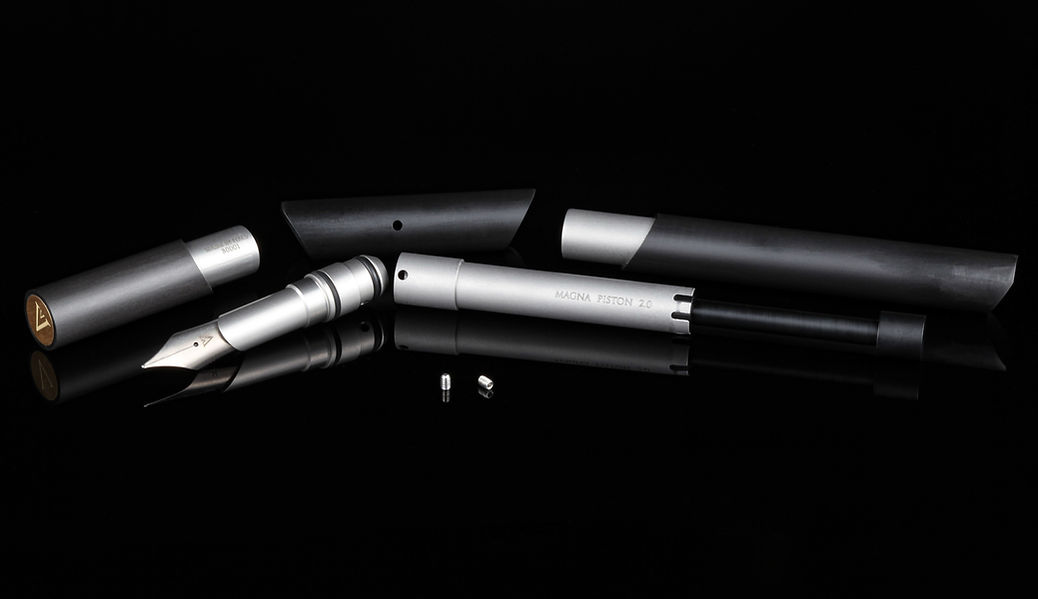
Though taking your pen apart will void the warranty, it is more there to show how everything fits together.

From our perspective there are three parts that slide together. The cap, the section, which contains the piston, and the barrel.

Anyone expecting a boy racer motor sport style weave will be disappointed as that is obtained by layering sheets of carbon fibre before baking (a process I actually part saw when being shown around the Racing Point (now Aston Martin) formula one team factory). Here rods of carbon fibre are used, so you do not get the weave effect but look closely and you will see the fibres all going in one direction.

There is a subtle warmth to the material, which I have to be honest I was not expecting. It is akin to an unpolished wood. It does make this a rather tactile pen despite the lack of angles and excrescences. While the three pieces are matched and from the same rod you can see the joins, not an issue and there is an indentation between the cap and barrel to let you know where the top of the nib is. A nice design touch.


Removing the cap is simply a case of sliding it off. There is resistance, so while a smooth action you do get the confidence that the cap will not accidentally fall off. Putting the cap back on is the reverse but you need to watch as it is easy to catch the metal hosting the nib unit if you are not careful. Also chances are you will have to twist the cap while pushing on to line things up. The finial contains the only external branding, a bronze (?) disk with the double V. Alas the V does not line up with the indentation, which is surprising as it appears to be glued in place (from looking inside).


The cap does post, sliding smoothly over the piston knob. Even with the steel tubing in the cap it does not affect the balance of the pen particularly, and as you will post the cap to secure it, not to extend the length, this is not something that is really required. The only slight catch is the cut angle at the back of the barrel is not lined up with the front so the visible gap which so helpfully shows you the nib alignment now is off centre and once seen it is hard to ignore. I suspect this is a downside to the fast the rods are hand cut and so might not be possible to remedy.

In the hand the Magna Piston 2.0 is very comfortable to hold. There may be no shaped section, but there is just the right amount of girth for me to not miss that (unlike something like a Lamy Dialog 3, which is just too wide). It also means finding a suitable position for your fingers is very easy and it gives the flexibility to adjust the balance point to suit you.


The nib is one of the key things here. It is an in-house item, as I assume is the plastic feed. From what I can tell it is friction fitted, though there should be no need to remove it. You have three options. Steel, titanium for €50 more (£42/$55, and 14k gold for €230 extra (£193/$252). I was asked which I would prefer and not being a fan of titanium went for a medium gold and boy was I glad, with one exception. This is a juicy and bouncy nib, fitting my personal preferences perfectly, except … there is a slight scratchiness to it. Under a loupe I can see a little chip on the inside of the tipping on the right tine. I am certain that some careful time with micro mesh would fix this, but it is not my nib or pen so I’ve left as is. Still this is a great writing pen. Side note on the £193 to upgrade the nib from steel to 14k gold. Onoto, for comparison, charge £200 though that is for an 18k nib, which would cost slightly more. I have just checked the Beaufort Ink website (UK distributor for Bock nibs) and the difference in cost there between steel and 14k gold nibs is £172, so for an in-house nib I do not see an issue with the price of the Venvstas nib. On the Northumbrian Pen Company website (UK distributor for JoWo nibs) the difference is £116, which surprised me as I though Bock and JoWo were competitively priced.


One thing you may notice from the picture of the feed is while from the top the nib, collar, and carbon tube all line up, underneath none of them do. This infers the steel clutches are also hand cut with slight variation in angles. This does not bother me but if you have a certain level of OCD then be warned.

The filling system is a push/pull plunger, again made in-house. From testing it holds about 2ml of ink. It takes a bit of pressure to push in and pull out, but the action is smooth, you do not feel like it is sticking. The one downside to the system is at the nib. As the supplied instructions and the website make clear, you need to avoid immersing the carbon sleeve. This means keeping a close eye on the nib as you dip it in to the ink and I actually found using an OMAS ink bottle the easiest method as this could sit at 45 degrees. I mentioned this to Filippo and he liked the idea, so if there is a redesign of the Venvstas ink bottles to make filling easier you will know who to thank 😉 .

Side note on the plunger. One concern other reviewers have given, resulting in also a warning on the pen website is over the exposed end of the piston when the pen does not have the cap posted. I have tentatively tried knocking and pushing it and found no movement, but it is still something to be aware of. To quote the website on this and filling:
The piston head is exposed and operable, be careful to avoid ink squirt.
To refill do not sink the carbon fiber to avoid ink to enter the cavity that host the cap.


To remove the barrel you just pull, it is stiffer than the cap. Having done so you reveal the text MAGNA PISTON 2.0. While on this subject, on the clutch pat of the cap is MADE IN ITALY and B0060, the latter the serial number of this pen. The B presumably is for a Magna Piston model. The black you see on it I believe (through examining with a loupe) may actually be carbon fibre scraped from the inside of the section. As the shell is several mm thick I would not worry about this. Re-attaching the barrel you have the same issue as with the cap, as in you need to watch as you initially slide it over the end of the piston and also you may have to rotate it to line up properly at the end.


Packaging wise everything is cardboard, great for those who do not keep. The box reminds me of a steel girder, with the top and bottom extending beyond the sides. Inside there is folder bit of card acting as an inner lid and a simple pen tray. There is not enough space for the instruction guide. Instead this is secured between the box and an outer cardboard sleeve.

So what do I think. I will admit I was not quite sure what to expect. I knew the much of the early history and I knew the previous reviews (which always makes things hard when you are trying to be impartial), but I was pleasantly surprised. Despite the scratchiness from the nib I have really enjoyed using this pen. There is something tactile about the material. Effectively when capped the Magna Piston 2.0 is just a rod of carbon fibre, but there are times I have just picked it up to feel/rub the smooth surface and to feel the slight warmth. Writing with it has been a joy.

All is not perfect though. This may be a handmade pen, but it is meant to be one by craftsman and you are paying accordingly. My issues are all small niggles, but are also either limitations due to the method (i.e. the cutting of the rod) else a slight lack of attention to detail in the final finish such as the cap finial liming up properly. The chip in the tipping could also have been picked up if each pen were to be dip tested before sending out. With making their own nibs I would have hoped Venvstas would have been able to do this. Still that 14k gold nib is glorious.

I know some people have questioned the price, but for me €239 (£200) for a handmade luxury pen is reasonable enough, even with the imperfections, and while with the gold nib that price rises to €469 (£394) I still think this is a reasonable price for what you get.

Would I recommend this pen to others, well now we fall in to the usual caveats I throw up with many a more expensive pen. Ideally you want to try one of these for yourself to see if you find it comfortable to hold. Also you need to be aware of the care required with filling the pen. The cartridge/converter version is just €10 less, however it is the same nib and feel, just easier to fill as it allows you to pull the converter to fill through a syringe tip or another pen (or even injecting ink in to the converter with a syringe). Certainly this is a uniquely different pen, but that can count both ways and if you tend to spot imperfections and then get frustrated over them then I would suggest this is not for you, but for many of us this could be an interesting alternative. Nib wise, I am not a fan of titanium, but the gold nib is potentially worth the extra cash.
Pros:
- Bouncy wet nib.
- Decent fill from the piston.
- Piston rod requires pressure so no risk of accidentally pushing it in by catching the back of the barrel.
- Interesting design.
- Warm in the hand.
- Posting the cap does not really back weigh the pen or affect the balance point.
Neutral:
- No shape to the section.
- Need to look when closing the pen to make sure the cap and section line up properly.
Cons:
- Filling can be a bit of a pain.
- Scratchy nib (on this pen).
- For a hand made and assembled pen not everything lines up neatly.
Writing Sample:

Comparison Pictures:


- Back in Mid to late 2015 Paris based Italian designer Lucio Rossi appeared on the Fountain Pen Network forums talking about a new a carbon fibre fountain pen he had designed and was about to launch on Kickstarter. It quickly became clear Lucio was not a fountain pen user but had approached the pen using design and architectural principals. The campaign worked but the pen reviews were not good and we rapidly saw on the forums that Lucio was a man of passion who did not hold back. Now at the time it was not clear whether Lucio owned or worked for Venvstas, or even if that was just a brand he used for Kickstarter and he worked for another studio. A number of newer models, also made of carbon fibre, appeared before the D’Art, an usual pen with a claim it was designed for comfort when doing calligraphy. It had a triangular section, but the opposite way round to the Lamy Safari and OMAS 360, with the flat part on top. Needless to say it was not received well. Not long after a new company appeared on Kickstarter, U75, with a pen which appeared to be a cheaper version of the D’Art but with the triangular section being in the correct orientation, The Edge. This is where things get darker as only half of the backers received their pen and Lucio vanished. I documented this and my view of the pen back in December 2019, as I mentioned near the top.
Roll on several years and Lucio Rossi and the Venvstas brand suddenly reappeared. Turns out that Filippo Carmignani Tirelli had approached Lucio Rossi over moving the company forward and they went into partnership, so the period of silence was due to the move to Parma and the start of ‘Venvstas 2.0’. Good for the company, but not so good for the backers of The Edge who never received their pens. New designs came, still using the same design philosophies and with the pens still being made out of carbon fibre. A piston filler appeared but it was flawed and reviewers slated it resulting in some rather public and private ranting by Lucio. At some point after that he left and Filippo took total control of what I would now consider to be ‘Venvstas 3.0’. Designs were tweaked and updated, new models have appeared and Venvstas also launched a range of inks. ↩︎
 dapprman
Rossi is now under his own brand, LRD design
Great review. I am in agreeance, the section is shapeless and that is not a plus. I am intrigued by the feed. I don’t see feeds with fins that have a swoosh like that.
The design still seems like a typical case of form over function to me. Given the rather unpleasant backstory of the brand, this is one pen I will definitely not buy.
Pingback: Sunday Reading for July 21, 2024 - Madcity Supplies
💓💚❤️ Great review
Blessed and Happy afternoon
🌹🪻🍀🌺🏵️🌸🪻
Pingback: Gravitas Carbon Fibre Piston Test Bed | dapprman