Tags
fountain pen, Gravitas, Gravitas Ultimate Vac, Ultem, Ultem Fountain Pens, Ultem Pens, Vac Filler
It could be argued that Ben Walsh has taken the fountain pen world by storm with his takes on materials, finishes, engineering and experimentation. How many of us would normally eschew the bright and the bling yet now possess a skittles finished pen. His experiments with concrete failed, yet this has not stopped him and we have now have his take on the bulk and vac fillers. It is the latter I review here.
Now it must be remembered, before anyone screams Visconti, Pilot, or TWSBI, the vac filler is one of the oldest surviving fountain pen filling mechanisms out there. Even when ONOTO used it with their The Pen at the start of the 20th century (as the plunger filler) it was not original.

One of the problems that has been seen with demonstrator vac fillers is cracking at key stress points. Now I must caveat that for the Pilot 823 every case I have seen has been after the pen has been disassembled for cleaning, something that Pilot states voids the warranty. Thing is though that with demonstrator pens there could be a need to do a thorough clean, especially if a saturated or high sheen ink has been used. This was a challenge Ben could not ignore and thus came about this design with titanium reinforced areas.

The metal components at the stress points are not the only design feature as Ben has included a large secondary reservoir between the plunger seal and feed (the fore-chamber). This is not obvious at first and if you do not read the pen description or ask Ben (mea cuple …) you will miss it as much of this chamber is hidden within the titanium band.

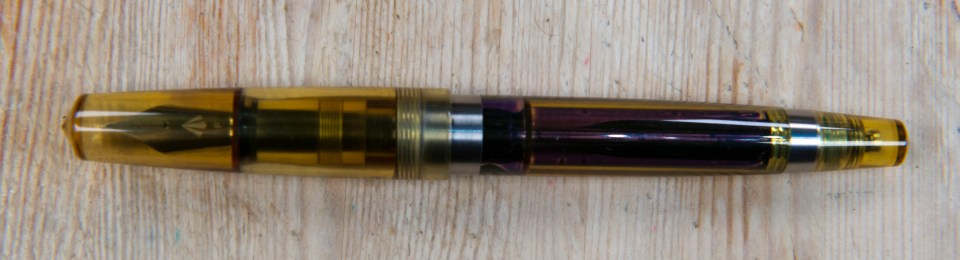
At the time of writing the Gravitas Vac is available in two main materials, colourless acrylic for €180 and polished Ultem® at €200. It is the latter I bought, with its naming being a play on the material. The Gravitas Ultimate Vac. Now Ultem® is becoming popular for fountain pens with more and more small makers using it, however with those I’ve seen, such as with the Kasama one I was leant and previously reviewed, their finish often is imperfect as this material is very hard and tough with the result it can be a lot of work to completely polish out the turning marks. Not so here where there is not a scratch in sight.
Now for me the colour of Ultem® can be hit or miss. It can depend on the finish, the thickness of the material, and even the type of Ultem® used as there are several variations. I do dislike the cloudy, pasty, lighter yellow you occasionally see, however here you have a bright amber. The sort that makes you think of amulet jewels containing unlucky ancient insects.

Looks and size wise this fits in neatly with the Gravitas design language and I assume was heavily influenced by the Sentry model with which is shares dimensions. The peaked cap finials are common across much of the Gravitas range with the exceptions being the original torpedo shape, the Torque and the Quark.


The cap removes in just over two turns and you can see an inner step/seal which does work well. You will also notice the ink splatter as it was this pen that was the source/influence behind my recent post on uncapping pens. The actual point in time when I noticed I was spinning the body of this pen in and out of the cap was while chatting with Ben over the Vac model on Instagram …..

All I will say is if we see a Gravitas fidget spinner pen I will claim responsibility for a little bit of the inspiration….

The cap does post securely and relatively deeply. Due to just being Ultem® it does not move the balance point back particularly far, so if you do have very large hands or prefer posting the cap it should not be an issue.

The section angles downwards in a nice curve towards the nib before rapidly rising out again to keep the fingers away from the inky bits. It is of a reasonable length and I have no problems finding a comfortable grip. The titanium threads are part of the barrel and feel as if they are a slight step up from the section, however they are not, it is the first thread itself. These are angled slightly away from the nib so you do not feel them while holding the pen or moving your finger across them from front to back, however in the other direction they are slightly noticeable. Moot as you are unlikely to shuffle your fingers forwards to find a more comfortable grip. It is one thing to be aware of though. Moving rearwards and the threads become a barrel ring, key to this design as this is where you mainly see cracks on other brands of vac filler. The band then merges near seamlessly with main part of the barrel. Nice trick as both titanium and Ultem® can be hard to work with.

Width wise I would consider the section and barrel of the Vac to be ‘normal’ for a modern pen, certainly not as wide as an oversized so I think it will work well for most users.

Near the rear of the barrel you have another piece of titanium, as a combination of a ring, the threads for the blind cap, and the guide for the piston rod. Another traditional cracking point for vac fillers that Ben has looked to reinforced. As with the cap threads part there is a near seamless transition between the Ultem® and the titanium. The blind cap itself is also the plunger knob and held securely in place by the plunger rod.

I have confirmed with Ben that the #6 steel nib the pen uses is ‘off brand’ but uses a JoWo collar. This explains why it feels more like a latest generation unbranded Bock with an unusual feed. The only markings on it are the Gravitas symbol and the nib size. Size wise I went with a fine steel nib and it was sweet out of the box. I did check with Ben if he tuned everyone. He does not however he does inspect every nib under a microscope and corrects any issues. I feel this is something he should put on his website as I know he can be slow with turning round orders and things like this do mitigate the customer view if they feel they are waiting too long (especially after a big sales such as Fountain Pen Day or Black Friday resulting in lots of orders).


For those to whom a vac or plunger filler is new, the mechanism works by a seal being at the end of a rod, these days rubber, back in the 1920s, cork. When closed the seal securely blocks the main reservoir from the fore-chamber and feed. To fill the pen, the knob at the back of the pen is unscrewed and pulled backwards as far as it will go (normally the end of the chamber), drawing the seal up. The piston is then pushed forwards with the nib dipped in the ink. As the seal is pushed down it creates a vacuum behind it. Towards the front of the chamber there is a widening and when the seal reaches this the vacuum is released and the ink pulled into the barrel. Normally this will not fully fill the barrel, but repeating the process often will. There are guides online on how to fully fill a vac filler (Google for filling a Pilot Custom 823 or Visconti Power Vac).


One of the key benefits to a vac filler is the sheer ink capacity, here over 2.5 ml, and when there is a fore/pre chamber, even more. This latter part is so large on this pen (over to 0.5ml apparently) that the one downside is not an issue. The need to open the back every so often to let more ink get to the feed and nib. In fact it is so large that at first I thought the plunger seal was leaking as I could not see the ink level drop. Of course being a muppet I found out the hard way by removing the section with the plunger closed and watching as a load of ink dropped in to the sink (I was not a total muppet).

In the hand the pen is very comfortable to use. It is very easy to find a comfortable grip and the pen is very well balanced. The actual balance point is towards the rear despite the large piece of titanium middle front, however when held for writing this transitions to just on the fingers (for me anyhow). I don’t know if this was by design or by accident but for me it works very well.


Packaging wise I’m guilty of forgetting what the outer component was, as inside the pen was contained within a leather Gravitas pen case with a fastener.

Am I happy I bought this pen. Yes. This to date is the best pen I think Ben has designed and produced. OK I’ve only had a short play with a Kakari bulk filler, purely a quick scribble as it belonged to some one else, and that also comes with a gold nib as standard and far more engineering complex filling mechanism, however my initial reaction was I preferred the Vac (plus it is considerably cheaper).

At €200 would I recommend this pen and is the Ultem® worth the extra €20 over the clear colourless acrylic? To the first part, yes. If you want the capacity and can afford the cost, then this is a superb pen and the large fore-chamber means you do not have the more traditional issue of only being able to write a small amount before opening the seal. On the latter, personal preference really. I have mixed views on Ultem® due to the finish you often see, but here it is spot on and personally I think it looks better than the clear acrylic version.

Is there anything I feel is wrong with the pen. No is the simple answer however I do wish there was a clip, and I need to caveat that. At present (I do not know if Ben has anything planned) no Gravitas pen comes with a clip and to implement one is not a simple matter, especially if the excellent cap seal all Gravitas pens seem to have is to be maintained. Additionally Ben would need different size and types of clips for each model, which probably would be cost prohibitive. We do see many small pen makers who use a generic clip across their ranges and these tend to look cheap and detract from the rest of the pen. Additionally most pen collectors seem to just use pen cases to carry their working collection around meaning the vast majority of Gravitas customers would not be interested in one. I am certainly in the minority being someone who wants to clip a pen to the inside pocket of a jacket.
Pros:
- Attractive design.
- Fit and finish.
- Wrote well out of the box.
- Large ink capacity.
- Large fore-chamber ink capacity.
- Designed with cleaning in mind.
- Perfect balance point for me when writing.
Neutral:
- Would be nice if there was a clip option, but that probably is just me.
Cons:
- Nothing I can think of.
Writing Sample:

Comparison Photos:
Here not only with the ubiquitous Lamy Safari/Al-Star, but with three of the Vac’s rivals, a TWSBI VAC 700R (Iris), a Pilot Custom 823 (Amber), and a Visconti Homo Sapiens Power Filler (Caput Mundi).


 dapprman
I am not familar with Ultem® but I like the yellowish color. I wonder how it holds up to stains – Noodler’s Baystate Blue would be a good test but not on that pen. What is the diameter of the barrel?
Interesting question. The material is designed for medical use, but that does not guaranty it is immune to staining, though it is meant to be highly chemical resistant.
I’m not going to test mine with Bril Laurel Rose, which is as bad as BSB.
Barrel is 14.0 mm at the widest (central titanium). Any particular area you want me to measure ?
Ian Schon tested one of his Ultem pens with BSB and posted about it on Facebook. http://tinyurl.com/yqea2r6s
Thanks
At the central titanium ring is the perfect spot. The chemical sheet on Ultem indicates it is not resistant to ammonia – FYI
Pingback: Ultem® Fountain Pens – Hype or Here to Stay | dapprman
Pingback: Daily Carry – April 2024 Edition | dapprman
Pingback: Namisu Nova Titanium Pocket Pen in Ultem | dapprman
Pingback: End of 2024 and a Happy New Year | dapprman