Tags
Asvine, Chinese, fountain pen, Hong Dian, Hong Dian 1851, Hong Dian Forest, Hongdian, HongDian 1851, HongDian Forest
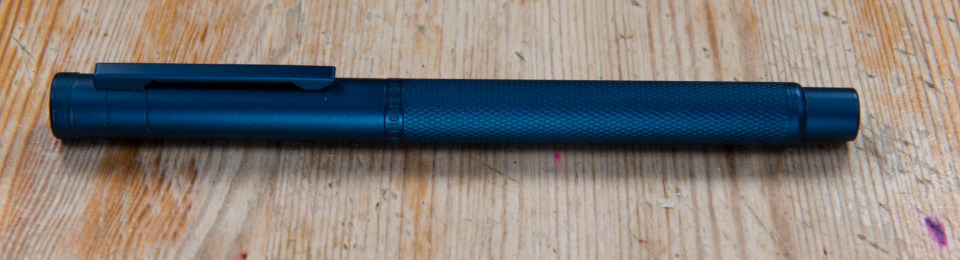
Do a search for the Chinese firm Hong Dian (also written HongDian) and you will find, primarily on Amazon or Etsy, a list of pretty generic fountain pens though none are clones and one model does stand out as slightly different. A thin straight pen which has obviously been designed for the cap to be posted. Depending on the colour or finish this pen either has no name or is called the Forest, though as far as I can tell the model is actually the 1851 (on etsy, however, the range of 1850-1861 is used).
One thing you will notice on doing a search for Hong Dian fountain pens is the Asvine brand will also be shown and for a good reason. The two brands are from the same company, or at least connected companies as Li Xiaohong owns Asvine and appears to be connected with Hong Dian (Zhejiang Lishui Lantian Pen Industrial Co., Ltd). The two brands produce original designs (or as original as you can be in the fountain pen world) while also making pens for Moonman, Jinhao, and Duke (and possibly also PenBBS and Wingsung).

The key thing is this is an original design out of China, not a cheap knock off clone, and all while still being sold at a low price.

Now I must admit I have procrastinated about writing this review for almost a year now. My nephew bought me this pen as a Christmas present last December as a request from me. It is not because I dislike the pen but more because I’ve had others I’ve more wanted to use, such as my Hakase (review soon I promise), plus other pens I have been leant for review. Additionally, knowing this pen would be used less, I loaded it with a shimmer ink, J Herbin 1670 Caroube de Chypre.


Partly due to the anodised colour the pen looks relatively simple but does have some nice adornments. The chasing on the barrel gives an almost industrial and purposeful look, though you are unlikely to be holding the pen this far back. The rings where the clip connects to the pen hints that there is actually a band in place, where as they are just impressed markings. Also the apparent cap band with the Hong Dian name on it, is actually the start of the barrel. All subtle things, but all add to a well balanced design.

The cap smoothly pops off. It clicks back on with a satisfying action and sound. It does not produce a perfect seal, but then the ink evaporation is very light, so it does a good job. The top of the cap sticks out slightly, almost hinting that it might be a button. It is impressed with LT Hong Dian 1851 and a logo.

The cap posts securely and by obvious design. Pulling it back off and you hear a pop as if the air had been pushed out. Needless to say with the cap posted this becomes a rather long pen, though not as back weighted as I would have expected. I think this is partly due to my holding of the pen slightly higher up (picture below).


The clip is a simple straight affair with a nub at the end. Looking inside it appears to be stamped aluminium with the sides folded in to give the impression of thickness and the end curved back over. At the cap end it appear to be attached by some internal clips folded over. It is stiff, very stiff, though the design of the nub does mean it slides over pocket seems with ease and the pen is kept in place. My only concern is stress on the mounting point could cause the fixture to fail and the clip become loose or come off.


The section is of a reasonable length though thin, which is unsurprising considering the narrowness of the pen (there is an English expression to describe my statement of ‘no sh*t Sherlock’). The tapering is straight with the bottom ‘ring’ being noticeable and so should prevent inky fingers. As someone who prefers pens with more girth, I find I hold this one further back, actually on the step between the section and barrel. It is nicely bevelled and so not sharp with the results I stop noticing the pressure after a very short time. With the cap posted (which I normally would not do) I actually find I hold this pen at the start of the chasing.

The nib is a small #5 steel unit. The feed looks like it might be from Bock, but then it could also be in-house. On this pen it is smooth and the ink flows well, even with a year of holding a shimmer ink. As with many of the 1851 Forest pens the nib is coloured to match the pen, but lightly anodised, not the heavy powder coating you see on many nibs. Additionally it is top side only, so the tipping was left untouched.


The filling system is converter, though the version surprised me as I assumed it would be either standard international or Jinhao, not proprietary. The last thing I expect was for my spare Lamy converter to fit, though it does not work in the other direction. You can buy replacements plus compatible ink cartridges from Amazon with little trouble.

So my thoughts. Well it is a decent pen for a decent price with some nice subtle character, available in a number of different finishes and with an interesting choice of nibs including a ‘bent nib’ (fude ?). Price wise in the UK you are talking £18-£30 depending on the colour and nib. It is not suitable for everyone due to its thinness and indeed that does cause an issue for me meaning I am unlikely to use this pen much. Still it it a good starter pen, and more importantly considering where it comes from, it is not just another cheap clone.

Would I recommend this pen to others? Well, if you are happy with narrower pens then why not. There are plenty of colours to choose from plus the potential of a cheap fude nib.
Pros:
- Unique design from China.
- Subtle design.
- Smooth writer.
- Good ink seal.
- Good price.
Neutral:
- Will be too narrow for some people.
- Proprietary cartridge/converter system.
Cons:
- None I can think of.
Writing Sample:

Comparison Photos:
With the ubiquitous Lamy Al-Star/Safari.


 dapprman
WOW that is a long pen when the cap is posted – good thing I don;t post caps. As I prefer narrow pens (this is a plus), and they travel in my pant pocket so no concern with the clip. I like the design and location of the logo. I am always on the look out for a Chinese pen that is unique and not a cheap knockoff. It reminds me a bit of my Hero 395, though much more modern.
It may not be a clone, but it looks very similar to the Otto Hutt Design04, including the cap profile and the ring at the base of the clip.
Lots of HongDian pens are based on designs from German pens and slightly altered to not make it 100% copies.
I can easily identify Pelikan, Graf-von-Faber-Castell and Otto Hutt pens.
Exactly ! It looks like a Faber Castell pen to me.
In this case, have a look at the Otto Hutt Design 04. It is much nearer to it than to the Classic collection of Graf-von-Faber-Castell.
By the way, Otto Hutt resides in the German area called “Black Forest”. Probably, this gave it the name.