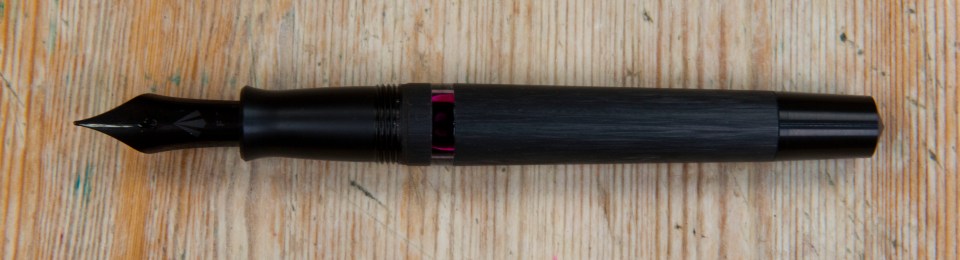
OK I admit I am starting this piece with a guilt trip. Mid this year Ben of Gravitas Pens was indicating he had a new piston filler on the way and chatting with him it sounded like it was due out early October, before the London Pen Show so I asked if I could borrow one for review …
Roll on to the show and Ben is present with Pen Venture, we talk and he passes me a large carbon fibre piston filling pen and being the only one there I thought the launch had been delayed and I would be able to time a review for when the new pen was about to go on sale.

Now caveat time. In discussions with Ben he highlighted this is a prototype both in material and the specifics of the piston mechanism. I have now seen photos of one other in use, however that may be a previous piston design and/or also smaller and maybe with a size #6 nib. Those of you who follow Ben’s work will know he does occasionally sell prototypes and one-off pens in his ‘Members Only’ section.

Second caveat time. At some point there may be corrections made to this post. I did send a draft to Ben to review/update/correct, after all this is not an actual pen review, but as is his tradition with comms I have not yet had a reply 😂, however when I do make any corrections I will update this post plus the title.

After refilling and some initial writing I started to ask Ben questions about the pen and its design to find that this was actually a one off test bed he had been using as a daily while deciding what to continue using. Now the guilt trip started as Ben was just being his usual friendly and helpful self while I now felt I had talked him in to lending me something personal and not a production model.

So I can’t review the pen as a whole, well I can but it would be to no one’s benefit, however I can look at the various parts, some of which we should see in future pens, others we will not.
The Material


While the section, piston knob and inner cap are all black resin, the main body and cap are from pultruded carbon fibre, similar to the material used in the Venvstas Piston Filler I recently reviewed. Suddenly my (mild) criticisms over the cutting of the lengths of the Italian pen were wiped away as Ben revealed to me he was unlikely to be using this material again in a pen of this size as he found that it cracked and split too easily resulting in much waste (I do note there there is a Gravitas Pocket Pen in the same material but that is much smaller). It is a shame as I like the feel and look of this type of carbon fibre, but you can actually see one slight split and another much longer at the opening to the cap.
The Ink Window

As Ben’s vacuum and bulk fillers have all been demonstrators (i.e. clear/transparent/translucent bodies) there has been no need for one of these in the past. If/when Ben starts to make a piston filler then I would expect this window to be present on solid bodies. As expected it is smooth and level with either side of the body, though there is a slight curve to the corners where window meets body, almost certainly on purpose to remove the risk of an edge that may be caught. Personally I like the fact it is external to the cap so you can see the ink level without having to open the pen.
The Piston Filling Mechanism

On this Ben was vague. True to form he has been experimenting and wants to improve on the common design which was arguably perfected by Pelikan. What is different I can not say nor see as the end of the piston does not wind down to the start of the barrel, so nothing to see in the ink window. Remember this is a test bed pen, almost certainly in a production model the plunger will be pushed right to the back of the feed to maximise a fill. Also I am not going to start taking apart a pen I have been leant (and one with potential proprietary designs in it which Ben needs to keep hidden).
The Nib


This is one thing I think we will see sooner rather than later and potentially there might already be Gravitas pens out there with this nib. Who makes it Ben would not say (I believe this might be contractual) however this fine tipped steel delight is a size #8. Yes you read that right. A steel #8 nib which I believe will fit suitable pens with a JoWo thread. While very stiff, possibly too much for my personal preferences, it is smooth and rather wet. I would suggest it writes closer to a Western medium nib than a fine, but that is based on the ubiquitous size #6. The feed appears to be plastic, not ebonite, for while I can see no moulding marks or protrusion, the surface has a shiny look and a lack of grinding marks. Actually, looking closely at the above picture, I think the feed may actually be 3-D printed.
Pen Size and Shape


This is possibly the largest pen I’ve handled from Gravitas and is actually slightly wider than the Flagship model. This is due to the design being based on the piston mechanism, the nib size, and limits of the material. Shape wise it fits in with the family look of the Entry, Sentry, Pocket Pen, Vac Filler, and Kakari.
Conclusion

This is normally the point where I describe what I do and do not like then list pros and cons. Well the obvious con is you can not buy this pen. In a world where the over-sized pen has become the norm this feels large but in a comfortable way. The weight and balance are good. There is a slight heft to the pen and it is comfortable in the hand, being helped by a decent sized section and soft capping threads.

The nib will be a delight to many. I personally do not see why there is such a desire for larger nibs, but it is there. Would this pen look worse with a #6 nib? No and I actually think it would be of a better proportion given the pen’s dimensions. Still a steel #8 is something many will want and it does write very well.

Alas I will now have to return this pen to Ben and I think I will miss it.
 dapprman
Pingback: Sunday Reading for December 1, 2024 (The Short Season Edition) – Madcity Supplies