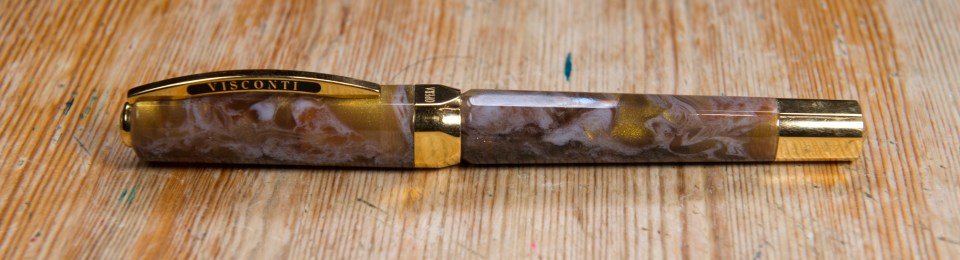
When talking about Visconti pens many will think either of the homo sapiens models (with the hook lock mechanism) else the lower end Van Goghs and Rembrandts. It is easy to forget that alongside high end limited editions there were also the Opera and Opera Master ranges.
The Opera and Opera Master models were both more traditional in having a metal section and cap threads, but at the same time different as they were octagonal in cross section, or more accurately square with the corners rounded off. The Opera was a standard sized pen taking a cartridge converter, where as the Opera Master, as we have here, was an over sized pen and used the Visconti double reservoir power-vac filling system.

I have been leant this pen by Penultimate Dave who reviewed it some five years back.


Well first off this is an attractive pen made of a striking resin. Translucent amber with lilac and grey swirls plus a dusting of golden particulate gives off an almost marble like vibe, though without the cold touch. Combined together with the golden coloured metal work and what we have here is very pleasing on the eye.


The cap unscrews in a turn and a half to reveal a metal section, almost rook like in shape from the threads to the end. The angle is shallow enough that you do not need to apply too much pressure to have a firm hold and thus it is not slippery in the fingers. The capping threads are hard but shallow, meaning while they are felt you rapidly stop noticing them and I had no issues with resting my thumb and part of my finger on them.


The cap itself is interesting for a number of reasons. You have the traditional Visconti bridge clip, which I have always found to be poor, despite the sprung hinge provided tightness. There is nothing underneath the start of the clip to provide traction, just smooth metal, so any pressure from below and the pen simply rises out of your pocket. Here the background to the Visconti on each side of the clip is black enamelled. At the top you have the ubiquitous Visconti My System finial, which personally I am fine with and have had no problems on my own pens though I do know someone who’s jewel (so not the standard finial as found here) did fall off. At the other end you have a cap band around the opening with OPERA on the front. however this is external only, as if to protect the resin from chipping. This means the threads are actually part of the acrylic material and here I do have a problem. I find the cap can be a bit fussy position wise on being closed and you do not want to force the issue as the barrel side threads are metal. I have found myself removing the cap part way through closing and trying again for safety. Additionally I would not want to force a tight closure to get the sides of the cap and barrel neatly lined up. I have found this is not always the case depending on which cap thread you pick up.

The cap will post, and here you have an advantage to the resin threads in the cap as they should not scratch the barrel, however this is a heavy pen and posting really throws the balance point out.


It is easy to find a comfortable grip as the section angles down about 7/8ths of the length before stepping back out to protect the fingers from the nib. I mentioned above this sort of shape very much reminds me of a chess piece. The threads at the back continue in the same line as the main part of the section and end at the ink window. Behind that there is a short stretch of resin before a large step up, however this is smooth and so far back it is unlikely to interfere with your grip. The barrel then gently tapers down towards the piston knob, which hosts the serial number.

This is a weighty pen despite being acrylic, coming in at 65.0g with the body being 45.4g and the cap 19.6g.

The nib is a fine sized 23k Palladium unit with a plastic feed. This pen must have been one of the early ones post the Visconti move away from gold. While I do know this is not the original nib I know Dave swapped it for an identical one due to the original being stiffer than he liked and also I think a little dry. So not to his taste but not a bad nib. One thing I think many of us have noticed is there can be a great variation in the feel between Visconti palladium nibs of the same size. The present one is slightly soft and bouncy, plus on the wet side.


The filling system is the double reservoir version of the Visconti Power Vac. Basically a vac filler with a smaller secondary tank where the ink view window is. This is between the nib and the filler seal. The system works well though you may have to pull and push the piston rod a few times for a decent fill. Not uncommon for any vacuum filler. One big advantage to this system is capacity. It is large and the secondary tank means you do not need to keep opening the valve every few lines, though the downside is you need to remember to empty the smaller chamber before taking the pen on a plane.

When new this pen was around $800 and appeared to sell out pretty quickly (there were only 60 examples) and so actually rose in value. I believe they now tend to go for around $1000, though at the same time it should be remembered we have been in a sellers bubble for around six years now so we could see prices suddenly drop across the board. There are newer versions of the Opera Master, going for between £570 (~€680/$753) and £840 (~€1000/$1100) depending on store, though those do not have the ink window and now uses the hook lock capping mechanism. Also I do wonder what other changes have occurred to bring the cost of the pen down.

So my thoughts. Well this is a hefty pen and always would have been just outside of my price range, however if I were willing to spend more at the time then I do not think I would have regretted it. Of course there is the question over the nib and Visconti’s reputation is still not that great, but assuming that was fine this would have made a good addition to my personal collection (I will be giving this back, Dave has my Nakayas as potential hostages). Would I have gone looking for an Opera Master? Well that is a slightly different question. It is an attractive pen but many of the finishes do not appeal to me. Also on the new version the lack of the ink window makes the body look oddly proportioned so I suspect if I were to be interested it would be one of the earlier models. To be honest there are a lot of different pens out there so this would be some sort of impulse purchase at a show rather than me tracking a particular version down.
Pros:
- Slightly different from the norm.
Neutral:
- May be too heavy for some.
Cons:
- Capping threads are not smooth and metal on resin could result in damage if forced.
- Clip looks good but is near useless.
Writing Sample:

Size Comparisons:
Here with the ubiquitous Lamy Al-Star/Safari and a Visconti Medici. Note the latter is considered an oversized pen by Visconti.


 dapprman
Pingback: Sunday Reading for September 8, 2024 – Madcity Supplies