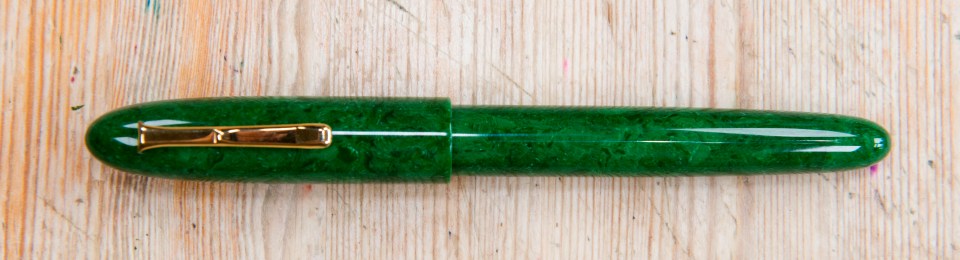
You would have thought having waited a year in the customer queue I would have been quick to review this pen while still under that honeymoon glow, but no for over a year passed before my first post and that was just on the ordering process. Now another 6 weeks have gone by and finally I have pulled my finger out to write this review of my Hakase NJ15A fountain pen though that in itself has led to a slight problem. Try finding an owner who has a bad word to say about their Hakase and you will see my problem. I do not want this to be love in but lets just say I am tempted to order another. Article over. Except this is not a pen for everyone and takes a lot of commitment and patience, so read on.

For those who are not aware, Hakase can trace their roots back to the 1920s, but it was 1982 when Harumi Tanaka started to make custom pens along with his future successor, Masaaki Yamamoto. There is some evidence Hakase was the first modern day company to start doing this. In 1996 Ryo Yamamoto began as an apprentice and started making pens in 2009 alongside Tanaka-san with the latter retiring in 2010. At the time of writing Yamamato-san has been hand making pens for 15 years. The video below is actually different from the ones in my previous article on the ordering process and was created by the YouTube Channel Process Maestro, with is being linked on the Hakase news page.
So where do I start with this pen. There are 2 size and 8 shape options resulting in 12 choices. I went with the large version of the simplest form, a cigar shape with no inserted metal work and a long clip. The 15A. The number I believe corresponds to the nib size (Pilot) with the smaller model options being 10A to 10D, the larger being 15A to 15H. With the smaller version you have the choice of a Pilot size #10 nib or a similar sized Sailor. With the larger size the only option is a Pilot #15 nib. All 14k and all branded Hakase. For Sailor this may not necessarily be uncommon, but Hakase is the only company Pilot do this for.

Now I have already covered the ordering process in my previous Hakase post, so I won’t repeat that here. Needless to say when I was informed the pen was finished and on its way I started to act like a little kid at X-Mas. Checking the tracking on a daily basis though I knew it was going to take a while to arrive.

I previously posted a short article including a link to my un-boxing video in which I had literally only removed the postage label and cut the tape before filming. I leave you to watch that to see how the pen is packaged and posted.


Shape wise you have two options, neither of which is particularly original. The A model is this classic cigar shape with the cap overlapping the barrel, meaning no sacrifice on the section. The only adornment is the clip, though I discovered by accident a number of months back that the creation date is engraved into the barrel near the bottom. It is only visible from certain angles when it catches the light and my discovery came about as I thought I felt a scratch on the pen. I am certain it was engraved as under a loupe you can see it was not stamped and certainly not laser engraved (which I doubt you could do to a celluloid pen due to the fire risk). Additionally with the creation date being 052023 you can just about make out that the twos are not quite the same.


The cap removes in just under two turns to reveal the short hour glass shaped section. The capping threads are shallow and you soon stop noticing them (I rest my thumb on the threads). The slight step up behind the threads is bevelled, so again in the hand you barely notice it. The edge to the cap is nicely rounded, so no sharp edges to catch. While you may assume this will be the case due to the pen being hand made, there are plenty of commercial pens at a higher price point that fail in this area.

The cap does post, with the inner cap being the securing agent. I am not sure if you would want to with this shape and I am sure some would be concerned about scratches from the threads, but even the inner cap ones are shallow (very). Having said that if you want to post your Hakase then the other shape may be the better option as that one is designed for cap posting.

The clip is secured behind the inner cap, presumably screwed in place. It is an interesting design with the dimple half way along its length and does suit the pen. Personally I am not a fan of the short clip that is standard on some of the other models, though that is more of a roll stop and I am sure you could ask for it to be changed. There is a decent amount of spring to not worry about securing on thicker seams and the tear drop nub at the end works well for allowing the pen to slide over and off a pocket.


It is very hard to define what makes a pen comfortable to hold, and it will vary from person to person, but I must admit I was slightly worried by the shape of the section as the similar but more pronounced version on the Pelikan M series I find does not work for me. Fortunately being shallower this has not been the case and instead in the hand I have found the pen has a very natural feel with the result I can write for a fair while without any discomfort.


For anyone who has a Pilot 723 or 823 the nib will be familiar. Unlike with Platinum and Sailor pens Pilot nibs tend to be softer, providing a little bounce and lacking the pencil like feel that can be so Marmite. Here, of course, you have the added fact that based on your supplied videos (or notes made if you go to the Hakase workshop) your nib is hand tuned. Now I must admit I was always a little nervous but my fears proved to be unfounded as my first try with this pen was an absolute joy. It does however mean anyone else trying my pen will need to hold it at a similar angle and rotation to me else they will miss the sweet spot. The feed is the appropriate one to the nib being used, so here the Pilot #15.

The filling mechanism is cartridge/converter with the type dependant on your nib make and the pen size. With the ’15’ models it is the Pilot Con 70N which I personally like due to the large ink capacity and the fact that using a syringe they are easy to clean. With the ’10’ models it will be either a Pilot Con40 or a Sailor converter. Obviously with all three options the relevant cartridge could be used instead. You could eye dropper fill this pen.

The quality of the fit and finish and the tolerances are superb, to a different level from what we are used to, but then when you look at the history of Hakase with how the master has always started as an apprentice in a sempai-kohai type relationship it makes sense. Hakase has very much followed the very Japanese tradition of preserving and maintaining high art skills.

One thing I forgot to mention in my ordering article is that the length of the pen is based on your form and supplied videos. It really is custom tuned to you. In discussion with Yamamoto-san we came to the agreement the pen would be 115mm in length un-posted.

So all is perfect ? Well there is one downside to choosing a handmade pen made of celluloid. The camphor smell. I did think this would fade with time but between fills I left the pen in its separate parts for about a week. A few days after re-assembling and uncapping the strong smell was back. This is actually common though and the reason you do not store a celluloid pen in a sealed area. As a side note, while not many makers use this material, the likes of Montegrappa use a modern form of celluloid, which while still flammable is a lot more stable with the side effect of a lot less of that scent.

So is this a fountain pen for everybody? No. It is the sort of pen you buy for life and with a commitment. While very few Hakase appear in the second hand market (which also shows how much owners like and respect their pens), those that do can struggle to sell partly due to not being a ‘bling’ pen and partly due to the nib being tuned for you. It is a risk you take if you are uncertain a Hakase may be a keeper. This also means it can be a risk buying one second hand. Sure if the nib can not be adjusted to your taste (there’s only so much a nib meister can do with a previously tuned nib, especially if originally not a broad or larger) then you could pull it and replace it with a Pilot/Sailor branded one, but then you can not buy those separately which would mean the purchase of a sacrificial pen. However if you are looking for a commitment and happy to both wait a year plus and to know that the nib is tuned based on your video footage, then this or one of the other models could be the fountain pen for you.

Would I get another Hakase? Well this was meant to be a one time only. I then decided if I saw the rare blue celluloid being available and the price not too much more than the jades then maybe. Now I find myself considering the red & black ebonite and the rosewood finishes (more likely the former) in the 15C format as seen in the video near the top (and yes I love the thought of an urushi finished Hakase, but that is well beyond my price point).
Pros:
- Exquisite build quality.
- Very comfortable in the hand.
- Hand tuned nib.
- Pen length specific to you.
Neutral:
- 12+ month waiting list.
- Time consuming ordering process.
- Camphor smell of the celluloid.
Cons:
- These are pens for life and if you do not like it you may struggle to sell.
Writing Sample

Size Comparison Photos
L-R Lamy Safari/Al-Star, Pilot Custom 823, Hakase, Nakaya Portable Writer (the latter can not post due to the thinness of the ebonite cap).

 dapprman
Pingback: Pens in Daily Use October 2024 | dapprman
Pingback: End of 2024 and a Happy New Year | dapprman
Pingback: Pens in Daily Use May 2025 | dapprman