Tags
EDC, EDC Fountain Pen, fountain pen, ION, Ion Infinity 2, Ion Infinity II, kickstarter, pocket pen, pocket pens, Titanium pen
ION is the brand mainly used by UK based designer Charles Lethaby for his writing implements. Starting his own design studio in 2014 he initially specialised in lighting, testing the Kickstarter waters in 2016 with an unsuccessful lamp project (at a far lower cost than his normal products). 2020 and second funded project came about, his first pen, the ION Pen. Part of its USP was that you could swap and change barrels, cap, section and both finials as well as being able to buy extra parts. The Infinity II is his third full design to be launched.
One difference between the original Pen and the Infinity and Infinity II is the latter two were both available as Compact, Regular and XL pens, whereas with the original Pen the different sizes were separate projects. I accidentally stumbled across this project and straight away was tempted by the titanium variant of the Compact pocket pen, with flat cap and threaded threaded barrel finials.

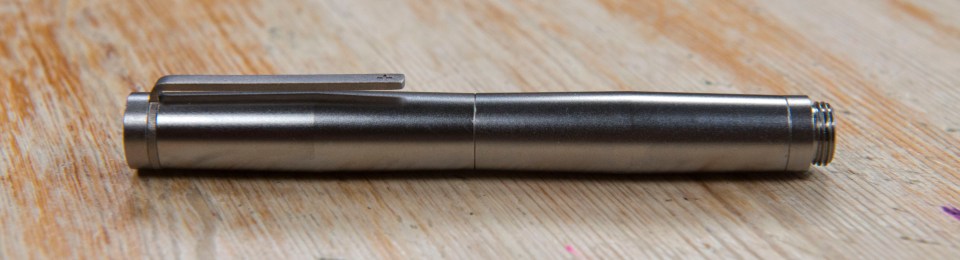
The shape of the pen is influenced by Constantin Brancusi’s Endless column in Târgu Jiu, Romania. A 30 meter column of 15 rhomboidal and two half rhomboid units. With the Compact you just have two rhomboids, whereas with the regular size you have three. While both are listed on the Kickstarter page, it is hard to tell what the difference is between the Regular and XL models.

In the flesh the angles are deceptively subtle. There is just 1 mm difference between the outer parts (12.9mm) and the wider centres (13.9mm). It is a trick of the eye which makes the outer parts look straight, but get the lighting right and suddenly the shape become more obvious. The two halves I would suggest are the same with difference in lengths being the finials I chose (there could have been the same) plus the clip (which is removable).


While my pen has a flat cap finial and a threaded barrel one (on to which you screw post the cap), you have the option for each end of flat, rounded, peaked, and threaded. Outside of the Kickstarter project you can also buy the flat and threaded ones with knurled edges. I failed to spot these were a £20 add-on option as I may have gone for them, though on a £75 pen this could be seen as a big jump in price. In reality I just saw the cost of additional finials, which came in at £60 total and so skipped. One thing that the Infinity II got very right, where so many others fail, is the threads on the finial to allow posting. These are not sharp. Sure they are hard but do you not feel you are at risk of cutting yourself.

The cap removes in two turns and shares the same threads as the barrel and so when the latter is not in place the cap can be wound further on. Why you do this I’m not sure, but it is worth mentioning anyhow. Holding both cap and barrel while unscrewing results in the former always coming off, so I suspect the inner threads on the latter may be tighter to make sure this always happens.


The clip is mounted on the threads of the cap finial, meaning you can move it round if you wish (by loosening the finial then tightening it again). It is a simple straight piece of metal and I assumed it would not grip, however there is enough texture that when slid over a pocket seam it does stay in place and does it’s job. Note this may be the result of being titanium, I can not guaranty the same will be the case for the aluminium version. The only markings on the clip is a + at the bottom, which is the branding for ION.


The section is a straight stretch from the end to the threads. There are just the one set of threads for both cap and barrel and as previously mentioned, the cap can be wound on far further than is necessary. It is not that long and surprisingly thin compared to the barrel. In some respects possibly a little too thin. The barrel edge is actually smooth and angled, with the result you barely touch the threads with your fingers, though they are not sharp. This does differ between the cap and barrel as they are the same external dimensions, however the inside of the cap is angled inwards to allow it have a flush fit.


I have average sized hands and I have to say that without the cap the pen is a bit too short for me. Net result you do need to post it, so a good job I chose the barrel finial with the threads. The only problem is this makes the pen too long. As a result I find myself holding the pen by the barrel, and this way the pen is nicely balanced and the nib still at a reasonable angle, but does feel a little odd.

Weight wise, being titanium there is a bit of heft. The Infinity II comes in at 44.1g, with the body alone being 25.1g and the cap 19.1g. I would expect the aluminium version to be ~5-10g less.

The nib is a size #6 Bock steel unit and I chose one in a fine size. It writes as expected. One thing though, and this is too common with metal on metal cap threads, it does dry out. Ink evaporation is a problem with this pen and my first fill disappeared within just 2 weeks. The top of cap finial also being a screw in component probably does not help. I suspect I ought to consider adding some grease to the threads of that finial (does not need to be silicon, could be something as common as Vaseline).

The filling system is international standard short cartridge. The barrel is too small to take a full sized converter, though I did find a Kaweco mini converter will fit with the piston fully extended. This is the route I have taken. Being metal on metal you will not be able to eye dropper fill this pen.


The box is a simple clam shell unit with a foam insert cut to safely hold the pen and minimal branding. It is held in a white cardboard sleeve. I honestly can not remember if the Infinity II came with any cartridges.

One thing I need to mention is my Kickstarter experience. This was Charles Lethaby’s 8th pen release through Kickstarter. Some may say he should just be selling through his store, but on this occasion I’m not so sure. After all his ‘bread and butter’ is lighting, the pens are only a side product and in reality it is just his third different pen as with the original there were separate project launches for each size plus the ballpoint. My purchasing experience matched that of the feedback I saw, very quick. He openly admitted he had some stock in place before the campaign was finished and sure enough mine arrived only about a week later.

So my thoughts. Well I can only comment on the pocket pen (Charles if you read this feel free to lend me a regular sized one 😉 ), though some observations will transfer across the sizes and also the other two fountain pens from the ION brand. The ability to chop and change the cap and barrel finials is a neat idea, though one where I suspect most of us will just use the flexibility for the initial look and feel and then never change things. Individually they are relatively cheap, however if you need a pair or want knurling then the price soon adds up. The downside to the finials is they can come loose. For me the one on the cap did so a few times when using the pen with my Midori Traveller Journal. With the pen secure in the loop I would unscrew the body for quick use, however when replacing the cap the clip would gradually be moved round to the back of the journal, at which point it would act as a lever and help the finial to start to unscrew. A side note I do like the fact you can change the position of the clip. The barrel one started to unscrew a couple of times when removing the cap from the barrel, though both times this was when I had passed the pen to someone else to try. I think it was just a case of them tightening the cap too tightly on the barrel. Oh, and in case you haven’t picked up on it yet, from both my initial views and from experience, I would recommend you get the threaded finial for the Compact version of the Infinity II (and probably Pen and Infinity models) as the pen is just too short to use without posting the cap.

Another advantage to being able to remove the cap finial is it allows you to remove the clip. There is enough space inside the cap that the finial can be screwed fully down without any risk to the nib. Of course there is also a downside to the removable finial and that is one more area where air can enter and assist with ink evaporation. This is a common issue with metal threads as they are not air tight, and while some grease could prevent this I would possibly prefer a soft plastic inner cap to be installed, however look inside the cap and you can see there just isn’t the spare width.

Though subtle I like the angles of the Infinity II. At first they are hard to see, but when your eyes adjust they just work and are something slightly different. I would be interested to see a Regular or XL sized pen with the extra rhomboid, and wonder if that would make the angles stand out more. I also like the width. As a compact pen you assume it is a pocket pen, and to a greater extent it is. Sure it is slightly longer than most, but it is also wider and that makes it a more comfortable pen to hold.
So what are the downsides, well ink evaporation is the big one and not easy to solve. Metal on metal threads are not air tight, though the more the rotations to open and close the cap the better it can be, but this can be a big turn off for some people and also detracts from the pen’s use as a quick note taker, which is exactly what I was using it for. The cap and barrel finials can become loose, though the former was down to my specific use and will not be a risk for most people and the latter easily avoided once you know how to best use the pen.
Cost wise I must admit I am a bit confused. The Kickstarter prices are very good, however the discounts mentioned would infer the final price would be a lot smaller than they appear to be on the Charles Lethaby website. Sure at present the Infinity II is not yet available there, but I compared prices of the Pen and Infinity models on the Kickstarter pages and compared with the website and on the latter they are more expensive than the pledge prices would infer. Having said that the final prices are decent for the aluminium Infinity pens and the original Pen models are all also good value. Still, with the present track record, buying through Kickstarter does result in some real bargains as long as you are aware of the downsides.
Would I recommend this pen to others? Well that partly comes down to use. Occasional note taker, then no due to the high rate of ink evaporation, it is why mine lasted less than a month attached to my journal. For regular use then possibly yes as it is an interesting and well made pen and, through Kickstarter, at a very good price, though in Compact guise one you will need to post to use. If that will make the pen too large for you then perhaps you should consider the Regular model.
Pros:
- Interesting and unique shape.
- Choice of finials.
- Good price (Kickstarter).
- Size #6 nib in a compact/pocket pen.
- Pens made in the UK (aside from Bock nib unit).
Neutral:
- For many could be too short without posting, too long posted.
- Compact version needs barrel finials to be threaded else cap can not post.
Cons:
- Finials can become loose (though once known normally avoidable).
- Ink evaporation.
Writing Sample:

Comparison Pictures:
First with some pocket pens, left to right: Shibui North Pocket Pen, 1970s Sailor Pocket Pen, ION Compact, Kaweco Sport, Gravitas Pocket Pen.


Now with the ubiquitous Lamy Al-Star/Safari


 dapprman
Pingback: Shibui North Copper Pocket Pen | dapprman
Pingback: Personal Fountain Pen Round Up for 2023 | dapprman